

The landscape of higher education has shifted dramatically. In 2026, a degree is no longer just a rite of passage; it is a high-stakes financial investment.
For the modern undergraduate, the “college experience” is being weighed against the cold, hard reality of the clock. Every hour spent in a lecture hall is an hour not spent earning, networking, or building a portfolio. This reality has birthed a new generation of pragmatic students who view their education through the lens of Return on Investment (ROI).
When you are balancing a side hustle, a part-time job, and a full course load, you realize that your time is literally money. Finding the balance between academic excellence and professional survival is the modern student’s greatest challenge. Often, the sheer volume of coursework can become a bottleneck to your career growth. In these moments, savvy students look for ways to optimize their output. Utilizing the best assignment help isn’t just about getting a grade; it’s a strategic move to reclaim hours that are better spent on high-impact activities like internships or skill-building workshops that actually move the needle on your future salary.
The Shift from “Learning Everything” to “Learning What Matters”
The traditional model of education encouraged a broad, slow immersion in various subjects. However, the 2026 job market demands hyper-specialization. Undergraduate students are increasingly focusing their energy on “core” modules that directly correlate to their career goals while seeking efficiency in elective or general education requirements.
This “triage” approach to studying is becoming a survival skill. If a module doesn’t contribute to your long-term ROI, spending fifty hours on a single essay for it might actually be a poor financial decision.
The Economic Reality of the 2026 Student
| Resource | 2010 Perspective | 2026 Perspective |
| Time | Unlimited for study | High-value currency |
| Degree | Guaranteed career entry | A baseline for competition |
| Experience | Gained after graduation | Must be gained during study |
| Support | Tutors and libraries | Digital academic ecosystems |
Opportunity Cost: The Hidden Fee of Higher Ed
Every choice in university has an opportunity cost. If you spend your entire weekend writing a 4,000-word report on a subject you don’t intend to pursue professionally, you are losing the opportunity to network at a local industry event or complete a certification in a trending software.
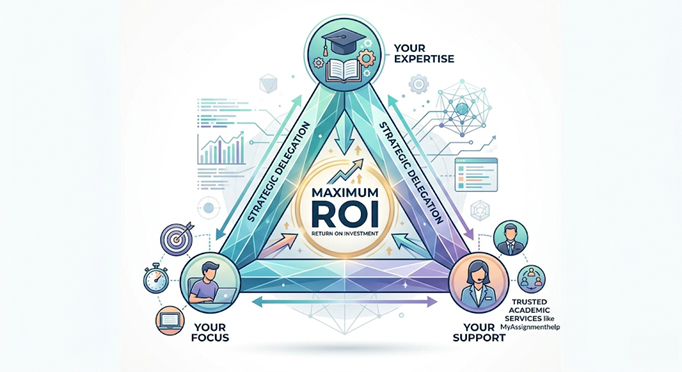
Gen Z and Gen Alpha students are masters of “outsourcing” the mundane to focus on the meaningful. This is where the concept of academic delegation comes into play. For a student working a $25/hour internship, spending 10 hours struggling with a complex statistics assignment might represent $250 in lost wages.
In this scenario, it makes perfect sense to pay for assignment writing through a trusted partner like MyAssignmenthelp. By delegating the heavy lifting of research and drafting to professionals, you aren’t just buying an essay; you are buying back your time to invest in your own career trajectory. This isn’t a shortcut; it’s a management strategy used by the world’s most successful CEOs, now applied to the world of academia.
How to Calculate Your Personal Academic ROI?
To figure out if your degree path is actually paying off, you need to look beyond the tuition fees. Consider these three factors:
- The Salary Ceiling: What is the average starting salary for your field? If the debt-to-income ratio is skewed, you need to be more aggressive about working while studying.
- The Network Effect: Is your university providing you with connections? If not, you need to spend less time in the library and more time on LinkedIn and at industry meetups.
- Skill Acquisition vs. Information Consumption: Are you learning how to do things or just learning about things? Skills pay the bills; information is often free online.
Why “Perfect” is the Enemy of “Done”
There is a psychological trap in academia called “The Perfectionist’s Deficit.” Many students believe that every single piece of work must be a masterpiece. While pride in your work is important, the “Done is better than perfect” mantra often yields a higher ROI.
If a “B” grade allows you to maintain your mental health and keep your job, while an “A” requires you to quit your job and suffer a burnout, the “B” is the higher-value outcome. Modern education is about sustainability. You cannot finish the race if you collapse at the halfway mark because you tried to sprint every single lap.
RELATED POST: Anonymous Image Board Platform
Strategies for Strategic Delegation
If you decide to use academic support services, do it like a professional. Don’t just hand over a prompt and walk away.
- Use the Draft as a Template: Learn from the professional structure and the way sources are cited.
- Fact-Check and Personalize: Add your own voice and specific examples from your lectures to make the work truly yours.
- Time it Right: Don’t wait until the night before. Delegate early so you have time to review the work and ensure it meets your standards.
Conclusion: Becoming the Manager of Your Education
At the end of the day, you are the CEO of your own life. Your degree is a product you are purchasing, and your time is the capital you are investing. Navigating higher education in 2026 requires a shift in mindset: stop acting like a student and start acting like an investor.
Whether it’s choosing which classes to take, which parties to skip, or when to seek external help to manage an impossible workload, every decision should be filtered through one question: Does this increase my ROI? If the answer is yes, proceed with confidence. If the answer is no, it’s time to pivot.
FAQ’s: Navigating Modern Academic Demands
Q: Is using assignment help considered cheating in 2026?
Ans: It depends on how you use it. Using these services for research, structuring, and as a model for your own work is a common study strategy. It’s about using the resources available to you to achieve the best possible outcome.
Q: How do I know if an assignment service is reliable?
Ans: Look for transparency. Reliable services provide clear communication, original content, and have a track record of helping students succeed. Avoid sites that make “too good to be true” promises.
Q: Won’t I miss out on learning if I delegate assignments?
Ans: Not necessarily. If you delegate a task that is outside your core area of interest, you are actually freeing up “brain space” to focus more deeply on the subjects that matter most to your future career.
Q: How can I improve my ROI if I’m already halfway through my degree?
Ans: Focus on building a portfolio now. Don’t wait until graduation. Start applying your classroom knowledge to real-world projects or internships immediately.
Q: Does Google penalize sites that talk about assignment services?
Ans: Google prioritizes helpful, high-quality content. As long as the information provided is honest, well-researched, and adds value to the reader’s life, it can rank well.
About The Author
I am Harrison Walker, a dedicated academic strategist and senior content lead at MyAssignmenthelp. With over a decade of experience in the educational sector, I specialize in helping undergraduate students navigate the complex intersection of academic rigors and professional development.
